

The Chahdegal Balouch peoples’ territory of life is a powerful example of an interconnected social-ecological system in desert and semi-desert landscapes.
This case study was created by Hamed Shahiki, Nina Aminzadeh Goharrizi, and Ali Razmkhah for the ICCA Consortium’s Territories of Life Report 2021.
The report underscores Indigenous Peoples’ and local communities’ rights as the biggest opportunity to address biodiversity and climate crises.

580,000 hectares

Nomadic peoples migrated to Chahdegal 150 years ago

Custodians: Balouch peoples of Chahdegal, population 6,053

Photo: Hamed Shahiki
“Over the last 40 years, dealing with change has become an inevitable part of our life; however, the rich biodiversity of our territory of life has strengthened our resilience to cope with critical situations on our own.“
Sardar Ali Reza, of Shahiki tribe

Photo: Nina Aminzadeh
“Camels are everything for Balouch peoples. They are a part of our families. Balouch and camel are alike: calm and proud.”
Kad-Khoda, elder of Houthi tribe
The Chahdegal Balouch peoples migrate seasonally and have a strong affinity with their camel herds as well as the construction of vegetation-based wind shields to protect them from desert sandstorms. Through intentional conservation of their territory, both ecological biodiversity and human well-being are secured, ensuring long-term resilience and sustainability. Despite the severity and scope of natural and man-made threats, such as an upstream dam constructed in 2009, the communities continue to fight to keep themselves and the territory alive.
“Our territory of life has been forming our identity. We have learned to use our territory’s resources with care. If we build a new house, the previous one is not destroyed. We never throw anything away, but reuse it for a new purpose.”
Changiz [Genghis] — Elder of Kamalan-Zehi sub-tribe
According to the elders, the Shahiki tribe, part of the Balouch nomadic peoples of Iran, migrated to Chahdegal about 150 years ago. Fleeing government threats and other invading tribes, they found refuge in Chahdegal, an area of high biodiversity and rich in natural resources. It was during this time that the people of Shahiki started forming small villages and developing underground water systems (qanats) for agriculture to complement their more traditional nomadic lifestyle. This encouraged more Balouch sub-tribes to migrate to Chahdegal; nowadays, Chahdegal has a population of 6,053, consisting of two main tribes and more than 10 sub-tribes.
With rich biodiversity, wild and domestic flora and fauna play a key role in the resilience and sustainability of this environment (Aminzadeh et al. 2019). The Chahdegal Balouch peoples’ territory of life consists of several sub-sections and encompasses extensive areas of desert and semi-desert ecosystems, with a total of approximately 580,000 hectares (about half the size of Lebanon). As semi-nomadic communities, the Chahdegal Balouch peoples use Chahdegal strictly as their ‘wintering ground’ (Qeshlag), which is an arid landscape found in Kerman province, and the Kuh-e-Zendeh as their ‘summering ground’ (Yaklak), a semi-arid landscape situated in the Sistan and Baluchistan provinces of Iran.

Participatory map of the Chahdegal territory. Credit: CENESTA 2020
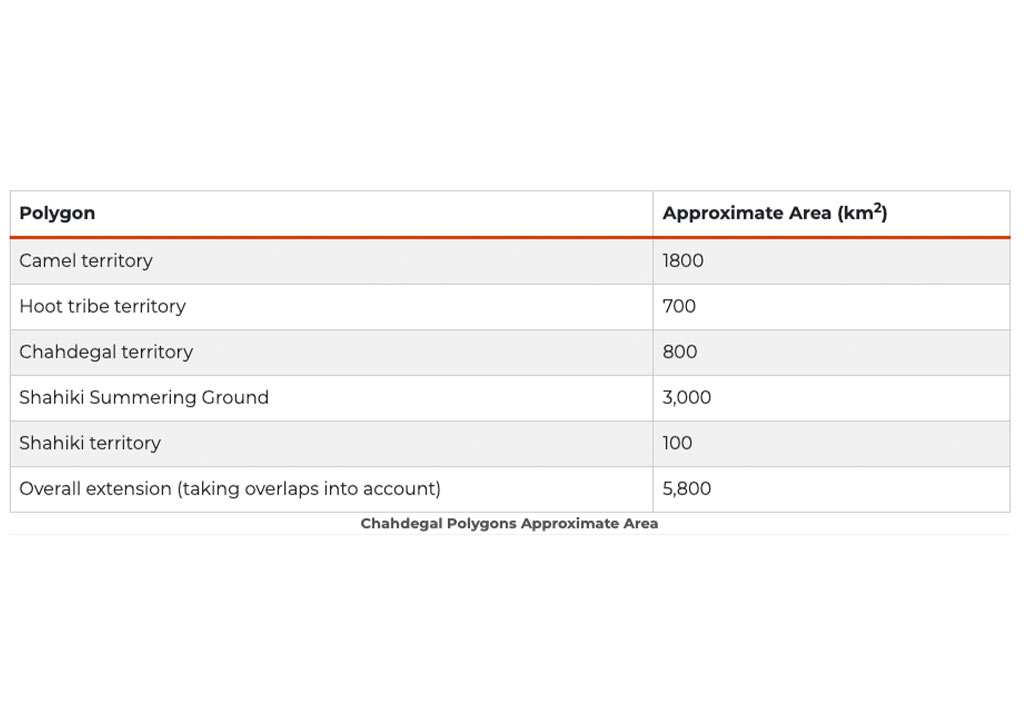
Chahdegal Polygons Approximate Area
The Chahdegal Balouch peoples identify themselves as Indigenous peoples belonging to the wider Iranian Balouch ethnic community. They have their own Balouchi language, religion (Sunni Islam, a minority in Iran), traditional culture, clothing and rituals. Their identity is profoundly linked with their territory, which holds a particular place in the community’s collective consciousness and shared sense of the past. This historic relationship with their environment means Chahdegal Balouch peoples confidently define their own territory, clearly demarcating their summering and wintering grounds, their migration routes and other related natural resources, as seen in the participatory project carried out by the authors (Aminzadeh et al. 2019). However, most of this remains unrecognized by the Iranian state.
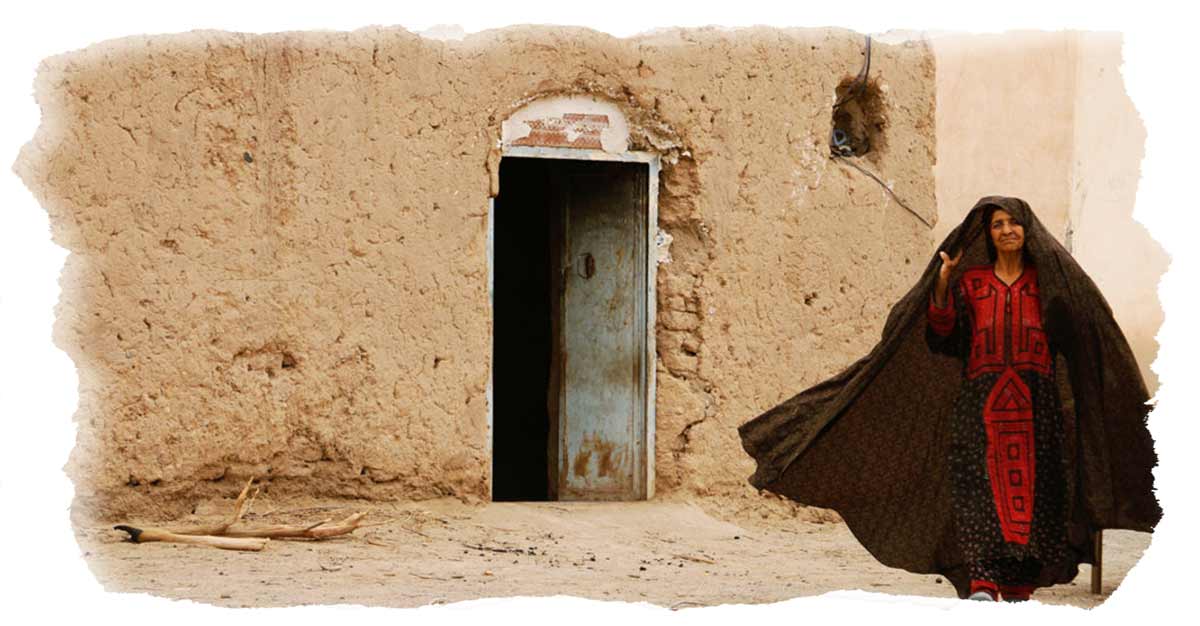 Photo by Hamed Jalilvand
The Chahdegal Balouch peoples have a collective governance system which includes decision-making institutions and various traditional governance methods founded upon the tribal social structure.
The main decision-making institution is the elders’ council of Chahdegal. This institution is structured around the Sardar (the headman of all the tribes), and other elders who will consult him in decision-making processes. The council is also formed of representatives of all sub-tribes who have the authority to manage parts of the territory of life and settle disputes. The council makes all its decisions based on traditional knowledge and experiences. These decisions are therefore considered fair and transparent by community members. Until 30 years ago, the council convened in a specific location called Kerteki. As communal land shared by everyone, the idea was that decisions taken on the Kerteki would be fair and unbiased. Today, the council meets in local mosques due to various religious reasons. Despite many challenges, the credibility of the elders’ council has enabled the traditional governance system to remain alive and dynamic in accordance with the changing needs of the communities and the environment.
Besides the council, the Chahdegal Balouch peoples have several other traditional methods of governing their territory. For instance, Tir-Andakhtan is a method to distribute farmland: an elder will demarcate various areas of land using a series of unique signs (small stones or animal dung, for example). Each sign will correspond to one individual farmer’s access to a certain area of land. The rationale behind this method, which is believed to follow a divine justice, is that each farmer has equal access to one good-quality area of land (with richer soil and nearby a qantas needed for irrigation), and one poorer quality area of land.
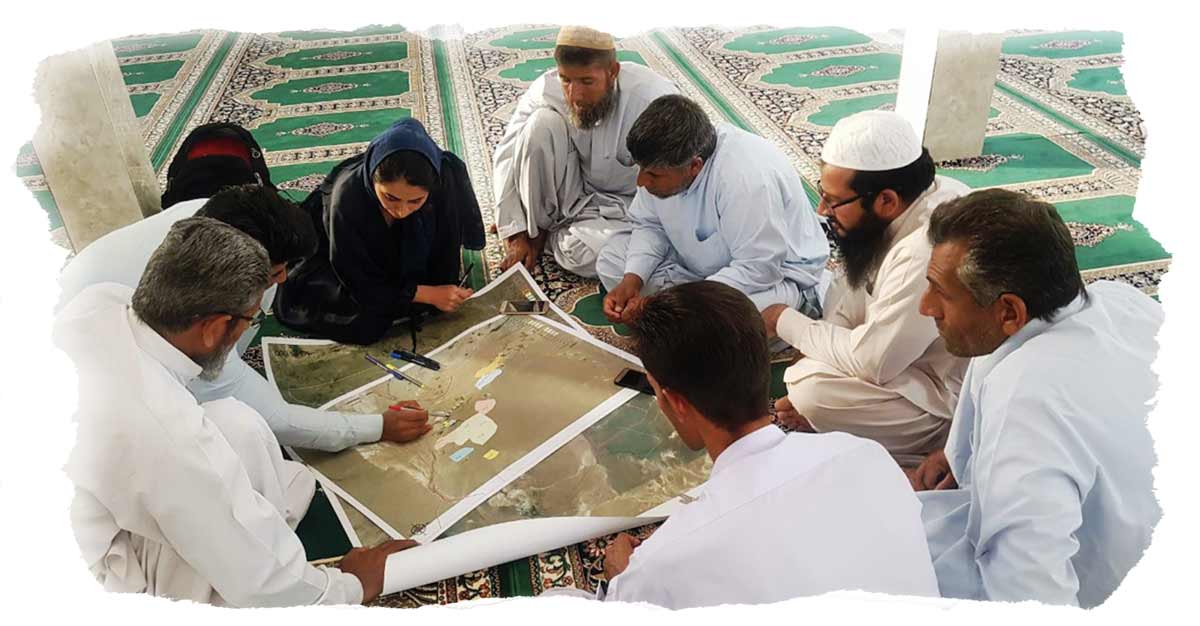 Photo by Nina Aminzadeh
The Chahdegal Balouch peoples have also developed regulations for the hunting of animals found in their territory such as wild boar, wild goat, rams and rabbits. Only a limited number of people, most belonging to the highest social caste, are permitted to hunt in common hunting grounds; the meat must be distributed among all members of the sub-tribe and outsiders are completely prohibited from hunting.
As is the case for other nomadic tribes, the government of Iran has nationalized the Chahdegal Balouch peoples’ ancestral territory. In addition, the summering ground of their territory of life has been designated as a government protected area. The communities have therefore lost their collective ownership of the summering ground; however, the government still respects their tenure rights and management methods, thus ensuring the continued conservation of this area and its rich biodiversity. In the wintering ground, the government has not taken serious action to restrict the communities’ access to farmlands. However, the communities are facing increasing challenges due to being prevented from planting palm trees on nationalized lands by the local natural resources office, as well as due to interference by local government authorities on their access to natural resources, including through judicial prosecutions.
The socio-cultural values of the Chahdegal Balouch peoples are intimately connected to their environment, as evidenced in their daily lives. For instance, many of the community’s cultural artefacts (carpets, tents and needlework) are made with local materials and adorned with patterns reflecting the flora and fauna, geography and climate. Houses are constructed using in-depth knowledge of local materials (such as brick, adobe, goat wool and dried Tamarix or palm branches) and in accordance with the direction and intensity of seasonal winds.
These socio-cultural values are also reflected in the unwavering spiritual relationship with the territory. In particular, the Balouch peoples’ relationships with the prosopis tree and with camels reflect their intrinsic gratitude for the gifts of nature that make life possible in Chahdegal. For example, it is under one particular sacred prosopis tree that the community performs several rituals, including the sacrifice of animals, and a ritual called Ziarat-e-Sed Soleiman, which consists of tying a fabric to its branches in order to wish for rain and good fortune.
In the Chahdegal Balouch peoples’ territory of life, the nourishment of the community depends profoundly upon the gifts of nature. Livelihoods are sustained by agriculture (cultivating palm, wheat, barley and alfalfa) and semi-nomadic pastoralism (herding camels, goats and sheep). All the community’s foods, as well as herbal medicines, come from their immediate environment. Some products like dates (one of the main agricultural products grown in Chahdegal) are sold in local markets, as are male camels and goats, which are sold in limited numbers and particularly during more arid years to prevent overgrazing of their own rangelands. Nevertheless, most products are consumed within the community. In this sense, knowledge of their natural environment, and their traditional governance and management systems, ensure that all the people of Chahdegal can subsist on the land. For example, Chahdegal Balouch women practice a participatory system to share goat milk among themselves, called Badali. This guarantees that all families have access to an appropriate amount of milk for food.
Traditional knowledge, values and practices contribute to Chahdegal peoples’ resilience to climate change and environmental degradation. Within their territory of life, they have detailed knowledge of at least four kinds of winds and nine different soil types. This means, for example, they know precisely where to plant prosopis trees as shields against sandstorms that would otherwise destroy villages and surrounding farmlands. They then know how to make use of soils that are brought by the wind and accumulate under the prosopis trees to improve the soil fertility of their agricultural lands.
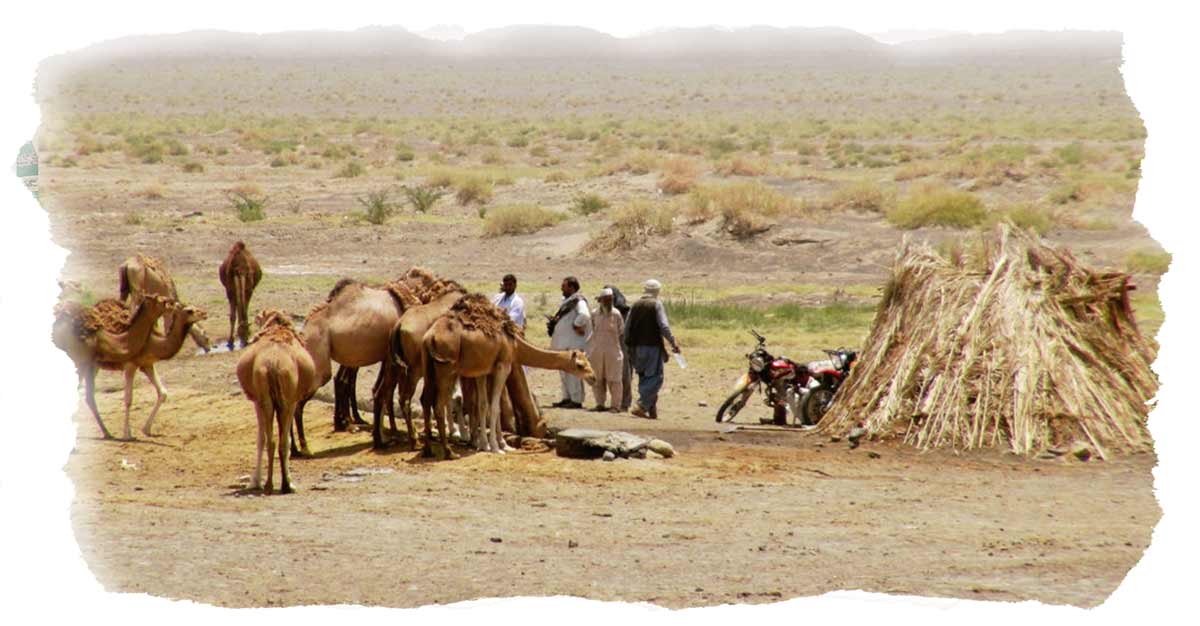
Photo by Ramin Rohani
The community’s relationship with camels also plays a significant role in the conservation of this territory of life. Due to camels’ ability to live in harsh desert ecosystems, the Chahdegal Balouch peoples have specific customary regulations for these animals, which prohibit the sale of camel milk and meat and only allow for camels to be slaughtered on a specific religious day, the Eid-e-Ghorban (feast of sacrifice). The community also makes extensive use of the fertilizing effect of camel dung in their fields and rangelands. Indeed, camel dung helps to enrich the biodiversity as it distributes seeds of wild flora such as Prosopis, Calligonum, and Desmostachya bipinnate.
As camel herders, Chahdegal Balouch peoples identify deeply with these animals, imbuing in camels their own social values, establishing remarkably precise naming customs based on the camel’s age, sex and life stages. They even consider them as part of their own families.
Chahdegal Balouch peoples practice various customary herding techniques to prevent over-grazing and damaging floral diversity: for instance, Gole-Kardan involves an elder assessing the grazing capacity of the rangelands before livestock arrive in spring season; and Keid-Kardan means tying the front feet of the herd leader camel in order to control direction and range of its movements and, consequently, of the herd. Examples like these illustrate the intimate human-animal relationship of camel herding and livestock rearing in Chahdegal, a bio-cultural system optimized for the sustainable use of scarce resources of this semi-desertic territory of life.

Photo by Nina Aminzadeh
The Chahdegal Balouch peoples’ territory of life is currently facing a series of threats, both natural and man-made; water scarcity and seasonal droughts are exacerbated by climate breakdown and inadequate government policies, including the construction of an upstream dam in 2009.
Today, the communities are exposed to sandstorms for more than 300 days a year (a significant increase), which cause severe soil erosion; the construction of a dam and the propagation of borewells with motor pumps interfere with the traditional irrigation systems; and with underground water reservoirs decreasing, many Prosopis and Tamaris trees are drying out. The area’s rich biodiversity is in danger of depletion.
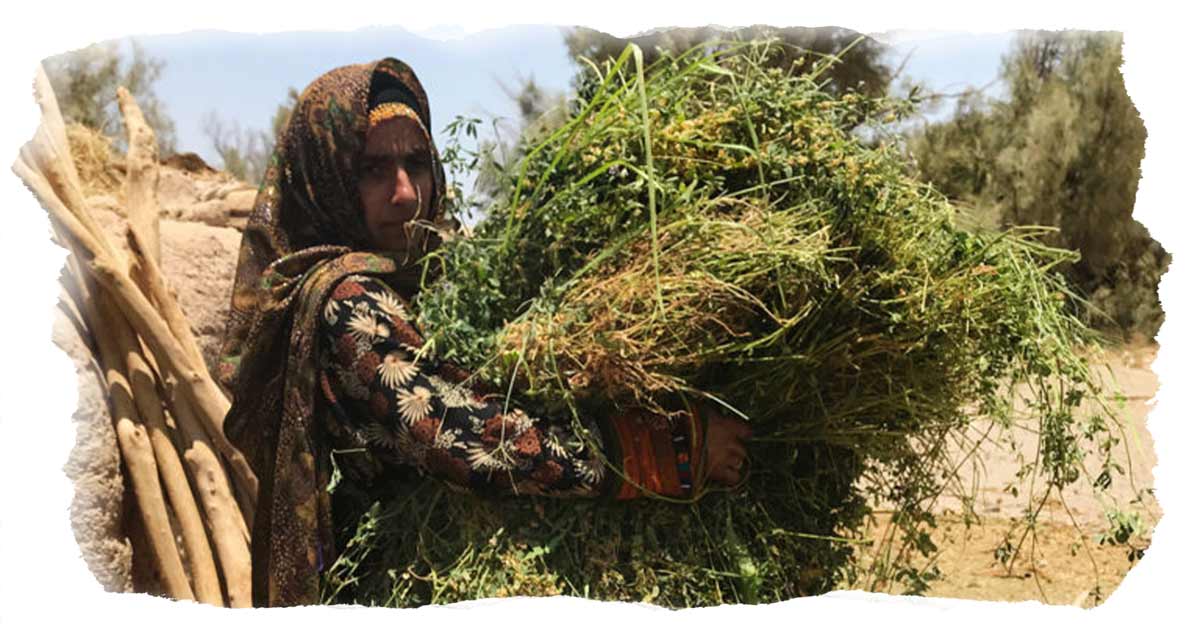
Photo by Nina Aminzadeh
The communities have developed several initiatives to deal with these threats. For instance, they have constructed windshields around villages and farmlands using natural materials (such as palm foliage or prosopis trees) to prevent the destruction caused by sandstorms. They have also planted drought-tolerant plants such as sour tea (Hibiscus sabdariffa) or other mixtures of wheat varieties that are adaptable to climatic change. Elsewhere, they have collectively reduced their grazing time in the summering grounds to allow plants to recover. This means that the community now stays in their summering ground for less than three months per year, compared to the five or six months they would have stayed there thirty years ago.
The communities’ resilience and ability to adapt to a changing environment is evident and will enable them to better cope with an increasingly uncertain future. The deep sense of communal solidarity, together with well-designed customary institutions, a migration-based lifestyle that allows for flexible adaptation and the profound knowledge of their environment, are further elements that enable them to manage their natural resources sustainably and conserve their territory’s rich biodiversity.
The Chahdegal Balouch people express a desire for the future of their territory of life to mirror as much as possible the lives of their ancestors. They know that the forces affecting their lives and their resources – such as the global climate crisis or top-down government interferences – are driven by other people’s activities at both local and global levels. An immediate hope is that state authorities will recognize the land tenure of their territory of life, as well as their water rights and customary irrigation systems. Ultimately, the Chahdegal Balouch peoples want to be able to strengthen their own customary institutions through integration of traditional and modern knowledge to combat the desertification of their land.
Hamed Shahiki, Nina Aminzadeh Goharrizi, and Ali Razmkhah for the ICCA Consortium’s Territories of Life Report 2021.
The report underscores Indigenous Peoples’ and local communities’ rights as the biggest opportunity to address biodiversity and climate crises.
All references and sources are available in the original case study.
Header photo by Hamed Jalilvand.
Discover this powerful example of an interconnected social-ecological system in desert and semi-desert landscapes.
